Best Remote Jobs for Stay at Home Moms: Flexible Work That Fits Family Life
Finding the best remote jobs for stay at home moms is not about finding the highest-paying job on a list. It is about finding work that fits around school runs, nap times, sick days, and the unpredictable rhythm of family life.
A remote job that demands fixed 9-to-5 hours with back-to-back video calls is no better than an office job if your toddler is home with you. The best remote roles for moms are the ones that let you work in blocks, pause when family needs you, and still earn a real income.
Remote work has changed completely in the last few years. Employers who once insisted on office attendance now hire fully remote teams, and many of those teams include parents working from home. Customer service, admin support, tutoring, writing, bookkeeping, and design work are all done remotely every day by people sitting at kitchen tables. The opportunity is real — but so are the scams, the low-paying gigs, and the jobs that promise flexibility and then demand a rigid schedule. This guide sorts the genuine options from the traps, explains what each role actually involves, and gives you a step-by-step plan to start earning from home.
Table of Contents
Quick Answer
The best remote jobs for stay at home moms are virtual assistant, remote customer service representative, online tutor, freelance writer, social media manager, transcriptionist, bookkeeper, and data entry specialist. These roles are fully remote, widely available, and offer the flexible or part-time hours that fit around childcare. Start by picking one role that matches skills you already have, setting up a quiet workspace and reliable internet, building a simple resume that highlights those skills, and applying through established job boards and company career pages. Avoid any job that asks you to pay a fee to start, promises unrealistic earnings, or refuses to name the employer.
What “Remote” Really Means for a Stay-at-Home Mom
Not all remote jobs are equally flexible, and the difference matters more than the job title. Before you apply for anything, understand the three types of remote work — because only one or two of them truly fit life with small children at home.
Fully Remote With Flexible Hours
These are the best fit for most stay-at-home moms. You have deadlines and deliverables, but you choose when the work gets done. Freelance writing, virtual assistance for small businesses, bookkeeping, and online tutoring booked by the session often work this way. You might work during nap time, after bedtime, and in the quiet hour before school pickup. The employer cares about the result, not the clock.
Fully Remote With Fixed Hours
These jobs are done from home, but on a set schedule — for example, a customer service shift from 9 a.m. to 1 p.m., or a remote admin role with core hours. They can still work well if your children are in school or nursery during those hours, or if you have childcare cover. The pay is often steadier than flexible freelance work, and many come with employee benefits. The trade-off is that you need reliable childcare during your shift, because you cannot pause a live customer call to change a nappy.
Hybrid or “Remote-Friendly” Roles
Some jobs are advertised as remote but expect you in an office one or two days a week, or ask you to attend regular in-person meetings. Read the job description carefully. If it mentions “occasional office days” or a location requirement, it is not fully remote. For a mom who chose to stay home, a hybrid role can still work if the office days are predictable and you have childcare arranged — but do not accept one expecting it to become fully remote later.
The Honest Truth About Working With Children at Home
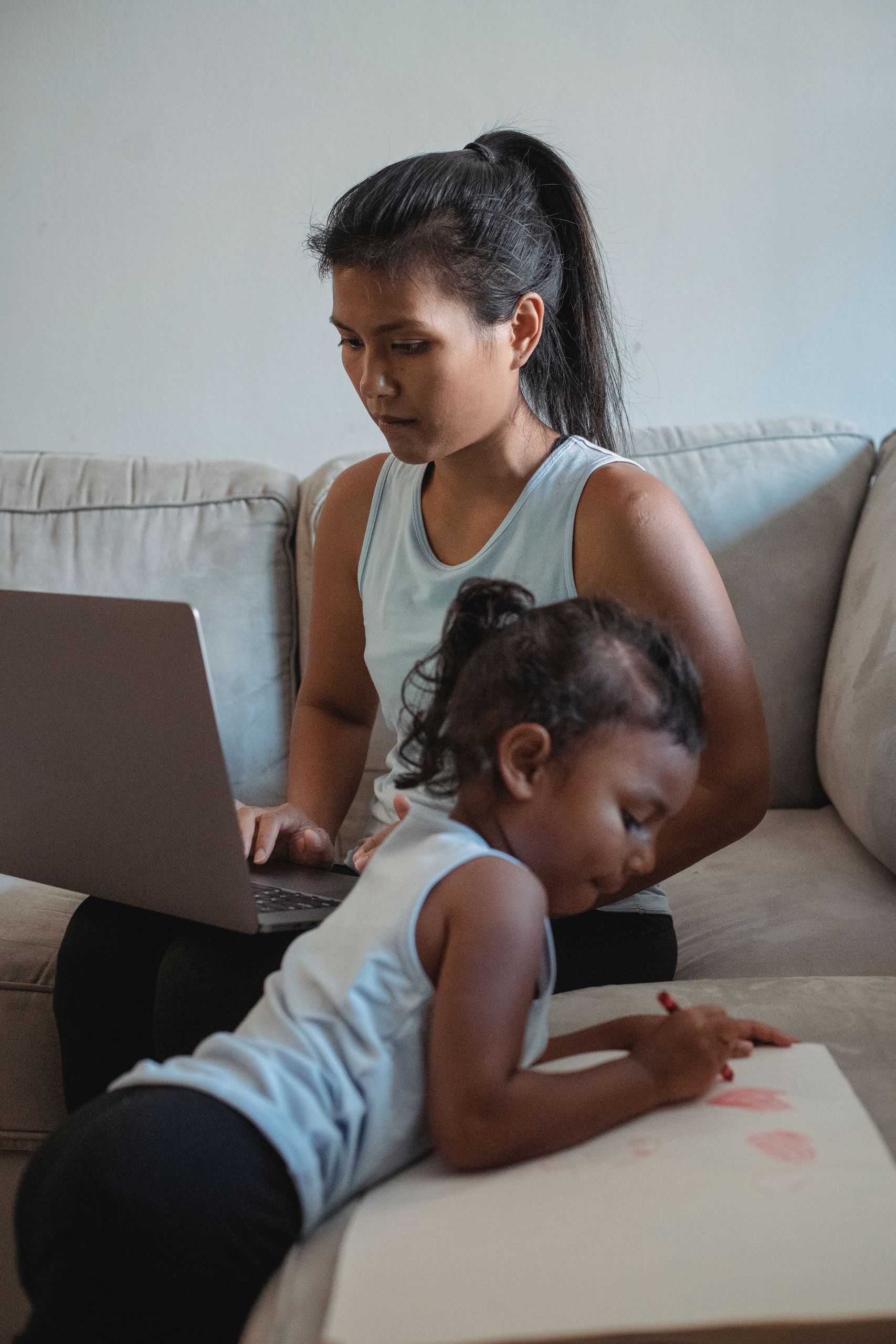
Working from home with a baby or toddler in the house is harder than the adverts suggest. Jobs that need quiet — phone calls, live tutoring, customer service — are difficult without childcare, even for an hour or two. Jobs that need only a keyboard — writing, data entry, design, bookkeeping — are much easier to do in short bursts around a child. Be honest with yourself about how much uninterrupted time you actually have each day. Many moms start with five to ten hours a week and grow from there. That is a realistic beginning, not a failure.
How to Choose the Right Remote Job for You
Do not start with a list of the best remote jobs for stay at home moms. Start with three questions about your own life, and let the answers narrow the list for you.
First, how many quiet hours do you have? If your children are at school, you may have a solid block of four or five hours a day. If you have a baby who naps twice a day, you may have two short blocks. Quiet-hour jobs include customer service and tutoring. Keyboard-only jobs include writing, data entry, and virtual assistance.
Second, what skills do you already have? You do not need a degree for most remote jobs, but you do need something an employer can use. If you organised a household budget, you have bookkeeping basics. If you ran a school parents’ group on social media, you have social media skills. If you wrote newsletters for a club, you have writing skills. Make a list of everything you already do — it is longer than you think.
Third, do you need steady pay or flexible pay? An employed remote role pays a regular wage on a regular schedule, which helps with family budgeting. Freelance work pays per project and varies month to month, but gives you more control over your hours. Many moms start with one steady part-time remote job and add freelance work on top once they are confident.
If you want a broader picture of all the options available to moms, including roles that are not fully remote, our guide to jobs for stay at home moms (https://careerschooled.com/jobs-for-stay-at-home-moms/) covers the full range. The rest of this guide focuses only on roles you can do entirely from home.
The Best Remote Jobs for Stay-at-Home Moms
Here are the strongest fully remote options, starting with the easiest to enter and moving toward roles that pay more as your skills grow. Each one explains what the work really involves, who it suits, and how to get started.

1. Virtual Assistant
A virtual assistant (VA) does admin work for busy business owners from home: answering emails, managing calendars, booking appointments, updating spreadsheets, posting on social media, and handling basic customer messages.
It is one of the most popular remote jobs for moms because the work is varied, the hours are often flexible, and the skills are ones many moms already have from running a household and organising family life.
You do not need a qualification to start. You need to be organised, reliable, good at written English, and comfortable with everyday tools such as email, calendars, and spreadsheets. Many VAs start by offering general admin help and then specialise — for example, in social media management for small shops, or in inbox and calendar management for coaches and consultants. Specialising usually raises your rate over time.
To get started, make a simple list of the services you can offer, set up a basic profile on a freelance platform or a small business job board, and offer your first few clients a clear, limited package — for example, ten hours a week of email and calendar management. Ask for a short written testimonial after your first month, because testimonials are what win the next client. Many VAs build up to a full client list within a few months through referrals alone.
2. Remote Customer Service Representative
Remote customer service representatives answer customer questions by phone, live chat, or email for companies that sell products or services online. This is one of the largest sources of remote jobs in the United States, and many employers hire part-time staff and offer training, which makes it a strong entry point.
The work suits moms who are patient, good communicators, and comfortable following a script or a help guide. Most roles need a quiet space during your shift, a reliable internet connection, and a headset. Some roles are phone-heavy; others are chat or email only, which is much easier if your home is noisy. When you apply, ask whether the role is phone, chat, or email — and choose chat or email if you have small children at home during your shift.
Pay is typically an hourly wage, and many of these roles are employed positions with a set schedule, which means a predictable pay cheque. Some employers offer evening and weekend shifts, which can suit moms whose partner is home in the evenings. The U.S. Bureau of Labor Statistics (https://www.bls.gov/) publishes employment and wage data for customer service representatives, and it is the best source for current, authoritative figures before you accept an offer.
3. Online Tutor
If you are good at a school subject — maths, English, science, or a language — online tutoring lets you teach students one-to-one over video call from home. Sessions usually last 30 to 60 minutes, and you can set your availability around your family schedule. Many tutors work in the late afternoon and early evening, when school-age children are home and looking for extra help, which can fit well if your own children are occupied or in bed.
You do not always need a teaching qualification. Some tutoring platforms require a degree or a teaching credential; others accept strong subject knowledge and a good trial lesson. English as a second language (ESL) tutoring is a popular entry route, and some platforms provide the lesson materials for you, so you do not have to plan lessons from scratch.
The key to success is reliability and patience. Students and parents book tutors they trust to turn up on time and explain things clearly. Start with a subject you genuinely enjoy and know well, prepare a few example explanations, and record yourself teaching a short sample lesson to check your sound, lighting, and camera angle before your first real session.
4. Freelance Writer
Freelance writers produce articles, blog posts, product descriptions, newsletters, and website pages for businesses that need content but do not employ a full-time writer. It is one of the most flexible remote jobs available: the work is entirely keyboard-based, deadlines are usually measured in days rather than hours, and you can write during nap times and after bedtime.
You do not need a journalism degree. You need clear, correct written English, the ability to research a topic quickly, and the discipline to meet deadlines. Many moms start by writing about subjects they already know — parenting, cooking, budgeting, local life — and then branch into business topics as they build a portfolio.
To get started, write three or four short sample articles on topics you know well, and keep them in a simple online portfolio or a shared document you can link to. Then apply for writing work on freelance platforms and content agencies, or pitch directly to small businesses whose websites have thin or outdated content. Early work pays modestly, but writers who deliver clean copy on time and learn a profitable niche — such as finance, health, or technology — can raise their rates steadily. Expect the first month to be slow while you build samples and reviews, and judge the role after three months, not three days.
5. Social Media Manager
Small businesses, local shops, and online sellers all need someone to run their social media accounts: planning posts, writing captions, replying to comments, and tracking what works. Many hire a part-time remote social media manager instead of a full-time employee, which creates exactly the kind of flexible role that suits a stay-at-home mom.
This role suits you if you already use social media every day, have a good eye for what makes a post interesting, and can write in a friendly, natural voice. You do not need a marketing degree. You need to understand one or two platforms well — Instagram and Facebook are the most common for small businesses — and be able to plan a week of posts in advance so the work fits around your family.
Start by managing one small account well, even if it is a local club, a friend’s business, or your own page. Learn the basics of scheduling tools, which let you prepare a week’s posts in one sitting, and keep simple records of what performs well. Results matter more than certificates in this role: a small account that grows steadily under your management is the best proof you can show a future client.
6. Transcriptionist
Transcriptionists listen to audio recordings and type out what they hear, word for word. The recordings might be interviews, lectures, podcasts, meetings, or medical dictation. The work is quiet, keyboard-based, and done entirely on your own schedule, which makes it one of the most childcare-friendly remote jobs — you can pause a recording whenever your child needs you and resume later.
You need fast, accurate typing and good listening skills, plus the patience to replay unclear sections until you get them right. Most transcription work is paid per audio minute or per hour of audio, so your speed matters: a beginner may take much longer than the audio length, while an experienced transcriptionist works far faster. A good pair of headphones and a quiet corner make a real difference to your speed and accuracy.
Start with general transcription on a freelance platform, where the entry requirements are lower, and consider specialising later. Medical and legal transcription usually pay more but need training and familiarity with specialist terms. Whatever you choose, take a short practice test first — most platforms ask for one — and be honest about your typing speed before you accept deadlines.
7. Bookkeeper
Bookkeepers keep a small business’s financial records in order: recording income and expenses, reconciling bank statements, sending invoices, and preparing simple reports. It is detailed, quiet, computer-based work that can be done entirely from home on a flexible schedule, and small businesses are always looking for reliable bookkeepers.
This role suits moms who are good with numbers, organised, and comfortable with detail. You do not need an accounting degree for basic bookkeeping, but a short online course in bookkeeping and a popular accounting tool such as QuickBooks or Xero will make you far more employable. Many bookkeepers start with one or two small clients — a local shop, a tradesperson, a freelancer — and grow by referral.
Accuracy is everything in this work. A single misplaced decimal can cause real problems for a client, so double-check your entries and keep clear records of what you did and when. Clients who trust your accuracy will stay with you for years, which makes bookkeeping one of the most stable remote income sources once you are established.
8. Data Entry Specialist
Data entry involves typing information from one place to another: updating spreadsheets, entering orders or customer details into a system, cleaning up lists, or transferring paper records into digital form. It is straightforward, quiet, keyboard-only work, and it is often available on a part-time or project basis.
The entry bar is low — you need accurate typing, attention to detail, and basic spreadsheet skills — which makes it a good first remote job while you learn other skills. The trade-off is that basic data entry is modestly paid, and it is one of the areas most often used by scammers, so you need to be careful about where you find the work. Genuine data entry jobs never ask you to pay to start, and they come from identifiable employers or established platforms, not from a stranger messaging you on social media.
Use data entry as a starting point, not a destination. While you earn from it, learn a higher-paying skill alongside it — bookkeeping, writing, or social media management — and move into that role when you are ready.
Remote Jobs You Can Start With No Experience
If you have been out of paid work for a few years, the idea of starting from zero can feel daunting. The good news is that several of the best remote jobs for stay at home moms genuinely welcome beginners, and employers care more about what you can do today than about a gap in your CV.
Virtual assistance, data entry, chat-based customer service, and general transcription all have beginner-friendly entry points. What they have in common is that the employer can test your skills quickly — a typing test, a trial email task, a short practice transcription — instead of relying on your work history. That works in your favour.
If you are starting with no experience at all, read our guide to work from home jobs for moms with no experience (https://careerschooled.com/work-from-home-jobs-for-moms-with-no-experience/), which covers the beginner routes in more detail, including how to handle the experience question in applications and interviews. The short version is this: pick one role, learn its core skill properly, build two or three samples that prove you can do it, and apply widely. Ten thoughtful applications beat fifty rushed ones.
What You Need to Work Remotely From Home
You do not need an expensive home office, but you do need a few basics in place before you start applying. Employers and clients will ask about them, and having them ready makes you look professional. Before you apply for the best remote jobs for stay at home moms, make sure these basics are in place.
- A reliable internet connection that can handle video calls without freezing
- A laptop or desktop computer — a phone alone is not enough for most remote roles
- A headset with a microphone, for calls, tutoring, and customer service work
- A quiet corner where you can work without background noise during calls
- An up-to-date CV that focuses on skills and results, not just job titles
- A professional email address and, if you freelance, a simple way to invoice clients
- A backup plan for childcare during live calls or fixed shifts, even if it is only an hour or two
You do not need to buy everything at once. A headset and a stable connection cover most beginner roles. Buy the rest as your income grows. And keep your work separate from family life where you can: a small desk in a corner, a set of work hours, and a simple rule that the laptop closes at dinner time will protect both your work and your family.
How to Find Legitimate Remote Jobs (and Avoid Scams)
Remote work attracts scams because it attracts people who need flexibility — and scammers know it. The most common scams aimed at stay-at-home moms are fake data entry jobs, envelope-stuffing schemes, mystery shopper jobs that send you a fake cheque, and “business opportunities” that ask you to pay for a starter kit or training before you earn anything. Learn the warning signs and you will avoid nearly all of them.
Where to Look
Start with established job boards that list remote work specifically, and with the career pages of companies you already know. Large job boards let you filter for remote and part-time roles. Freelance platforms are useful for writing, virtual assistance, design, and bookkeeping work, but read client reviews before accepting a job, and never work without a clear written agreement about the task, the deadline, and the pay. Company career pages are often the best source of employed remote roles with benefits, because the company is hiring directly rather than through an agency.
Networking helps more than most people expect. Tell friends, former colleagues, and local parent groups that you are looking for remote work and what you can do. Many remote hires happen through a recommendation, and a personal introduction is worth far more than a cold application. A short, honest message — “I am looking for part-time remote admin work, about fifteen hours a week, and I am good at email, calendars, and spreadsheets” — is enough to start the conversation.
Red Flags That Mean “Walk Away”
- The job asks you to pay a fee, buy a kit, or pay for training before you start
- The pay promise is unrealistic — full-time earnings for a few hours a week with no skills needed
- The employer will not give you a company name, a website, or a proper job description
- You are contacted out of the blue on social media or messaging apps about a job you never applied for
- You are asked to receive money and forward it somewhere else, or to cash a cheque and send part of it on
- The interview happens only by text chat and the “employer” avoids a video or phone call
- The job description is vague but the earnings promise is very specific
A genuine employer interviews you properly, gives you a written contract or agreement, pays through a normal payroll or invoicing system, and never asks you for money. If anything feels wrong, it probably is. Walk away and report the listing.
How to Check an Employer Before You Apply
Before you apply, spend five minutes checking the employer. Search for the company name plus “reviews” and “scam”. Check that the company has a real website with real contact details. Look at their social media accounts — a genuine company has a history of posts, not an account created last week. If the job is on a freelance platform, check the client’s hiring history and reviews from other freelancers. These small checks take minutes and save you from weeks of wasted effort.
Your Step-by-Step Plan to Start Earning From Home
Here is the whole path in order, from choosing one of the best remote jobs for stay at home moms today to your first pay cheque.
Step 1: Pick One Role
Choose the role from this guide that best matches your skills and your available hours. Do not try to prepare for three roles at once. One role, learned properly, gets you hired faster than three roles learned thinly. The best remote jobs for stay at home moms start with one role that fits your skills and your available hours.
Step 2: Learn the Core Skill
Spend one to two weeks learning what the role actually needs. For a virtual assistant, that means practising email, calendars, and spreadsheets. For a writer, it means writing samples. For a bookkeeper, it means a short course and practice with an accounting tool. Free tutorials and short courses cover most beginner skills — you do not need to pay for expensive training to start.
Step 3: Set Up Your Workspace and Tools
Sort out your internet, your computer, and your headset. Create a professional email address. Set up a simple CV that leads with skills and includes any relevant experience — including unpaid experience such as organising a school fundraiser or managing a community group. Prepare two or three samples of your work.
Step 4: Build Proof You Can Do the Work
Employers hire proof, not promises. A writer needs samples. A virtual assistant needs a short description of tasks they can handle, with an example. A social media manager needs an account they have grown, even a small one. Create your proof before you apply, even if it means doing a small task for a friend’s business first.
Step 5: Apply Every Day for Two Weeks
Apply for a small number of well-matched roles every day, and tailor each application. Mention the specific skills the job asks for, give a short example of your experience, and state your availability clearly. Keep a simple record of where you applied and when, so you can follow up politely after a week if you hear nothing.
Step 6: Prepare for Interviews
Remote interviews usually happen by video call. Test your camera, microphone, and lighting in advance. Prepare a quiet space and, if possible, childcare cover for the interview itself. Have two or three short examples ready: a time you solved a problem, a time you managed several tasks at once, and a time you learned something new quickly. These examples matter far more than a long work history.
Step 7: Start Small and Grow
Your first job may be part time, or a short project, or a trial period. Take it. Do the work well, ask for feedback, and ask for a testimonial when it goes well. One good client or employer leads to the next, and most remote workers build their income gradually over the first three to six months.
Balancing Remote Work and Childcare
The hardest part of working from home as a mom is not the work. It is the balance. A few habits make it manageable.
Work in blocks, not in scattered minutes. Two focused hours are worth more than six distracted ones. If your child naps from 1 p.m. to 3 p.m., protect that block for your hardest work and leave easy admin for the evening.
Tell your family what your work hours are, even if they are short. Children understand routines better than we expect, and a simple rule — “Mummy is working until the timer rings, then we play” — works surprisingly well with toddlers and school-age children alike.
Keep work and family in separate spaces where you can. Even a small desk in a corner of a room helps your brain switch modes. When the laptop closes, the work day is over. Moms who let work bleed into every hour of the day burn out fast, and burned-out moms do neither job well.
Use the school day wisely. If your children are at school, those hours are your most productive. Do your hardest, highest-paying work then, and save routine tasks for the evenings. And plan for sick days in advance: agree with your client or employer what happens when a child is ill, and keep a small list of backup options, such as a partner, a grandparent, or a friend who can cover an hour.
Finally, be kind to yourself about the mess. The house will not be perfect. Dinner will sometimes be simple. That is the price of earning an income while raising children at home, and it is a price millions of moms pay gladly. Progress, not perfection, is the goal.

Common Mistakes to Avoid
Taking the First Offer Without Checking the Terms
A job that looks flexible in the advert may turn out to have fixed hours, weekend work, or an on-call expectation. Ask about the hours, the schedule, and the notice period before you accept. A clear conversation now prevents resentment later.
Paying to Start a Job
No genuine employer charges you to work for them. Training fees, starter kits, background-check fees paid to the employer, and “registration” charges are all signs of a scam. Walk away.
Trying to Do Everything at Once
Some moms try to start a freelance business, a blog, and an online shop in the same month. Pick one income stream, get it working, and only then consider adding another. Focused effort earns money faster than scattered effort.
Undercharging for Your Work
Beginners often set their rates far too low, hoping cheap prices will win clients. They usually win the worst clients instead. Research what others charge for the same work, start at a fair beginner rate, and raise it as you gain experience and testimonials. Your time has value, and clients who respect that are the ones worth keeping.
Working Without a Contract
Even for a small freelance job, get the task, the deadline, and the pay in writing — an email is enough. It protects you if a client changes the scope, delays payment, or disappears. Professional clients expect this and will not be offended.
Hiding the Fact That You Are a Mom
Some moms worry that mentioning children will put employers off. In practice, honesty about your availability builds trust. You do not need to give personal details, but stating your working hours clearly — “I am available weekday mornings and two evenings a week” — helps an employer plan around you and helps you avoid jobs that do not fit.
Getting Started Checklist
- Choose one remote role from this guide that matches your skills and available hours
- Check how many quiet hours you realistically have each day, and be honest about it
- Learn the core skill for your chosen role with free tutorials or a short course
- Set up a reliable internet connection, a computer, and a headset
- Prepare a CV that leads with skills and includes unpaid and volunteer experience
- Create two or three samples that prove you can do the work
- Apply for well-matched roles every day for two weeks, tailoring each application
- Check every employer before you apply: real website, real reviews, no fees to start
- Get any freelance agreement in writing before you begin work
- Set your work hours, protect them, and close the laptop when they end
- Ask for a testimonial after your first successful job or month of work
- Review your progress after three months and raise your rates or hours if the work is going well
Conclusion
The best remote jobs for stay at home moms are not the ones with the biggest pay promises. They are the ones that fit your real life: your skills, your children’s ages, your quiet hours, and your need for a steady income. Virtual assistance, remote customer service, online tutoring, freelance writing, social media management, transcription, bookkeeping, and data entry all offer genuine, fully remote work — and several of them welcome beginners.
Start with one role, learn it properly, build proof you can do it, and apply steadily. Expect the first month to be slow and the first three months to be a learning curve. Moms who persist through that curve usually find that remote work does more than add income: it restores confidence, builds new skills, and proves that staying home with your children and having a career are not opposites. Pick your role today, take the first step, and build from there. Your family — and your future self — will thank you.
FAQ
What are the best remote jobs for stay at home moms with no experience?
Virtual assistance, data entry, chat-based customer service, and general transcription are the most beginner-friendly remote jobs for moms with no experience. Employers in these roles can test your skills quickly with a typing test or a short trial task, so a gap in your work history matters less. Pick one role, learn its core skill, build two or three samples, and apply widely.
How much can a stay-at-home mom earn working remotely?
It depends on the role, your hours, and your experience. Part-time remote work usually earns a modest income at first, and it grows as you gain skills, clients, and testimonials. Employed roles pay a regular hourly wage, while freelance work varies month to month. Be wary of any advert that promises a full-time income for a few hours a week — that is a common scam sign.
What remote jobs can I do with a baby at home?
Keyboard-only jobs work best with a baby at home, because you can pause and resume around naps and feeds. Freelance writing, data entry, bookkeeping, transcription, and virtual assistance are good choices. Phone-heavy roles such as customer service and live tutoring are much harder without childcare, because you need quiet during calls. Choose the role to match the hours you actually have, not the hours you wish you had.
Do I need a degree to get a remote job?
No, most of the remote jobs in this guide do not require a degree. Employers care about whether you can do the work: accurate typing, clear writing, good organisation, or patience with customers. Some roles, such as tutoring certain subjects, may ask for a degree or a teaching credential, but many remote employers hire on skills and a short trial task instead.
How do I avoid remote job scams?
Never pay a fee to start a job, and never accept a role from an employer who will not give you a company name, a website, or a proper job description. Check the company online before you apply, look for reviews from other workers, and be suspicious of unrealistic pay promises and interviews held only by text chat. Genuine employers interview you properly, give you a written agreement, and pay through normal payroll or invoicing.