How to Become a Graphic Designer Without a Degree: Portfolio First
Learning how to become a graphic designer without a degree starts with one fact that surprises most beginners: in graphic design, your portfolio matters far more than your diploma. Hiring managers and clients do not ask to see your degree certificate; they ask to see your work. A strong portfolio of real, well-crafted design projects will open doors that a degree alone never could, and a weak portfolio will close them even if you graduated from a famous design school. That is good news if you cannot afford university, if you are changing careers, or if you simply want a faster route into creative work.
This guide lays out the portfolio-first route in full: the core design skills you need, the tools to learn, how to build a portfolio from scratch with no clients, how to get your first paid work, what freelance rates and junior salaries look like in general terms, and how to keep growing once you are hired. It is a self-taught roadmap, but it is not a shortcut — becoming a good designer takes real practice, honest feedback, and a body of work you can be proud of. If you follow the steps, you can build a design career without a degree, one project at a time.
Table of Contents
Quick Answer
Learning how to become a graphic designer without a degree starts with a portfolio-first plan. To become a graphic designer without a degree, learn the core skills — typography, colour, layout, and branding — and the industry tools, then build a portfolio of strong self-initiated and real-client projects that prove you can solve design problems. A good portfolio, a simple website, and a few freelance or volunteer projects matter more to employers than a diploma. Apply for junior designer roles and freelance work with your portfolio leading the application, keep learning from feedback and professional resources, and let your work, not your credentials, make the case for you.
What Graphic Designers Actually Do
Graphic designers communicate ideas visually. They design logos and brand identities, social media graphics, posters, packaging, websites, advertisements, presentations, and printed materials. The work is a mix of creativity and problem-solving: a client has a message and an audience, and the designer must turn that message into something clear, attractive, and effective.
Most designers work in one of three settings. In-house designers work for a single company, designing everything that company needs. Agency designers work for a design or marketing agency and handle many different clients. Freelance designers work for themselves, finding their own clients and setting their own hours. Beginners often start freelance or in junior in-house roles, and many move between these settings over a career. Each has trade-offs: in-house work is steadier, agency work is more varied, and freelance work is more flexible but less predictable.
It is also worth knowing what graphic design is not. It is not only making things look pretty. A beautiful design that confuses the audience or misses the brief has failed. Good designers think about hierarchy (what the eye sees first), readability, the client’s goals, and the audience’s needs. That thinking is the skill employers pay for — the software is only the tool that expresses it.
The Skills You Need (No Degree Required)
Design Fundamentals
Before you open any software, learn the fundamentals: typography, colour theory, layout and composition, and visual hierarchy. Typography is the most important of these — most design is mostly type, and a designer who understands font pairing, spacing, and readability already stands out. Colour theory covers how colours work together and what they communicate. Layout and composition cover grids, balance, and how to guide the eye across a page. You can learn all of this from free online resources, library books, and by studying designs you admire and asking why they work.
The Core Tools
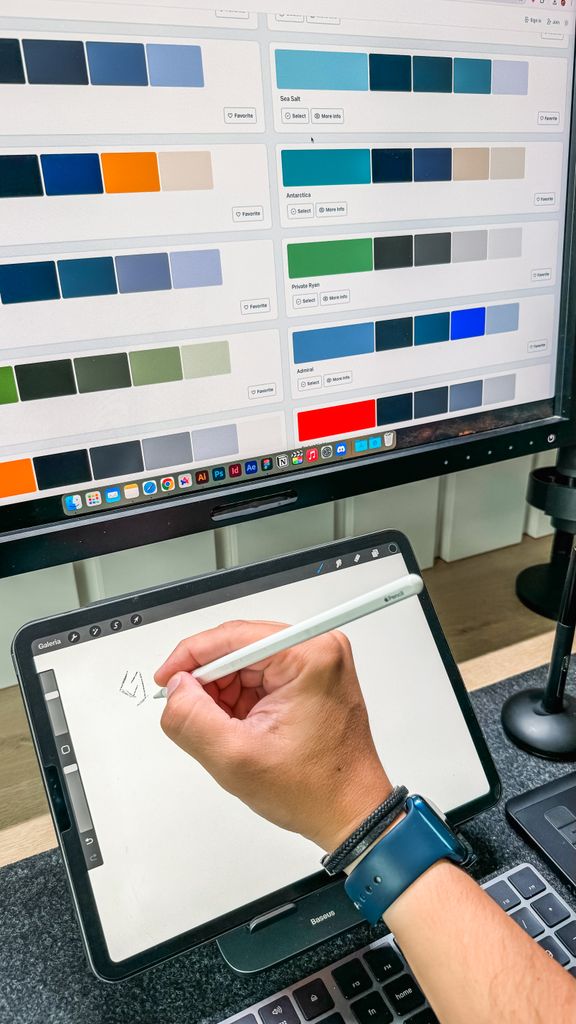
The industry-standard tools are Adobe’s Creative Cloud apps, above all Illustrator for vector graphics and logos, Photoshop for photo editing and raster graphics, and InDesign for multi-page layouts such as brochures and magazines. Adobe also offers Figma-style web tools and a free starter tier for some products, and many beginners start with free or low-cost alternatives such as Figma for interface and layout work, Canva for quick social graphics, and Affinity Designer and Photo as one-time-purchase alternatives to Adobe apps. Learn one tool deeply rather than five superficially: Illustrator is the best first choice for most aspiring graphic designers, with Photoshop second and Figma third if you want to move toward web and app design.
Do not let tool choice slow you down. Employers care about what you can produce, not which app you used to produce it. Pick a tool, learn it properly through structured courses, and practise daily. Free structured learning is widely available — check the learning resources published by AIGA, the professional association for design, and Adobe’s own tutorials, and use them alongside practice projects.
Branding and Identity
Branding is the work many clients ask for first: a logo, a colour palette, fonts, and rules for how a brand looks everywhere. Learning to design a simple brand identity — logo variations, business cards, social templates, and a one-page brand guide — is one of the most useful skills a beginner can build, because it appears in portfolio after portfolio and in job descriptions everywhere.
Web and Digital Design Basics
Most design work today is digital. You do not need to become a web developer, but you should understand how designs work on screens: responsive layouts, common web image sizes, social media formats, and basic accessibility such as readable contrast and legible type sizes. Learning Figma and the basics of how websites are built will make you more useful to employers and clients, and it opens the door to interface design work later. Our guide to the most in-demand skills explains which digital skills employers are asking for most right now.
Communication and Client Skills
Designers spend a surprising amount of time talking: understanding a brief, presenting ideas, handling feedback, and explaining design choices. Learn to ask good questions before you start designing — who is the audience, what should they do after seeing this, what must it include, what should it avoid? Learn to present two or three options with reasons, not ten options with none. And learn to take feedback without taking it personally: a client asking for changes is not rejecting your talent, they are refining the result.
The Self-Taught Learning Plan
Months 1–2: Foundations
Spend the first two months on fundamentals and one tool. Study typography, colour, and layout for an hour a day through free courses and books, and practise in Illustrator for an hour a day: recreate designs you admire, trace logos to understand their construction, and redesign bad posters or adverts you see in daily life. Keep everything you make, even the rough work — it shows your progress and gives you raw material for your portfolio later.
Months 3–4: Guided Projects
Work through structured projects: design a logo for an imaginary coffee shop, a poster for a music festival, a social media campaign for a local charity, and a packaging concept for a food product. Use realistic briefs — write a one-paragraph brief for each project before you start, including the audience, the message, and the constraints. This habit is what turns exercises into portfolio pieces: a portfolio piece needs a problem and a solution, not just a pretty image.
Months 5–6: Real Work and Portfolio Building
Start doing real work, even if it is unpaid at first: volunteer designs for a local charity, a school, a community group, or a friend’s small business. Real clients teach you things exercises never will — deadlines, feedback, revisions, and working within someone else’s taste. Choose these projects carefully: pick ones you can do well, that you can show publicly, and that teach you something. One strong real project is worth five imaginary ones in a portfolio.
Ongoing: Feedback and Iteration
Get feedback constantly. Join an online design community, share your work, and ask specific questions: “Is the hierarchy clear?” is a better question than “What do you think?” Study the feedback, revise your work, and keep the before-and-after versions — they make excellent portfolio case studies. Follow professional designers, study award-winning work, and keep a swipe file of designs you admire with notes on why they work.

Building a Portfolio Without Clients
Your portfolio is your degree, your CV, and your interview all in one. It needs to show that you can solve real design problems, not just that you can use software. Aim for six to ten strong pieces rather than twenty average ones.
What to Include
Include a mix that shows range: a logo and brand identity project, a poster or advertising piece, a social media campaign, a piece of print design such as a brochure or menu, and a digital piece such as a landing page or app screens.
For each project, show the thinking: the brief, your research or inspiration, sketches or early concepts, the final design, and how it would look in use — a logo on a shop sign, a poster on a street, packaging on a shelf. These mockups make your work look real and professional, and they show employers you understand context.
Self-Initiated Projects That Look Real
If you have no clients yet, invent realistic briefs and treat them seriously. Redesign the branding of a local business you like, with a written explanation of what was wrong with the old design and what your version fixes. Create a full campaign for a fictional product, from logo to social posts to packaging. Enter design brief challenges published by design communities — they give you a real brief and a deadline, and the results are portfolio-ready. The key is to present each project as a case study with a problem, a process, and a result, not as a single image with no explanation.
Building Your Portfolio Website
Put your portfolio on a simple, fast website — your own name as the domain if you can, or a free portfolio platform if you cannot. The site should load quickly, show your best work first, and make it easy to contact you. Include a short about page that explains who you are and what you do, and keep the writing plain and honest: you do not need to pretend to have a degree or agency experience you do not have. Employers respect a clear, honest story backed by strong work far more than an inflated one.
Getting Your First Paid Work
Freelance Platforms and Local Work
Many beginners find their first paid jobs on freelance platforms, where small businesses post design jobs and designers bid for them. These platforms are competitive and the pay for small jobs is modest, but they are a real way to build paid experience and reviews. Price your first jobs fairly but not desperately low — underpricing hurts you and the whole market, and clients who pay almost nothing rarely value the work. At the same time, do not turn down small local jobs: a logo for a local café, a flyer for a community event, or social graphics for a small shop can lead to repeat work and referrals, which are the lifeblood of a freelance career.
Applying for Junior Designer Roles
Apply for junior designer, design assistant, and production designer roles with your portfolio first and your CV second. Your application should link directly to your portfolio website, and your cover letter should mention two or three specific portfolio pieces and what they show. Many job adverts say a degree is required, but in design this is often a preference rather than a hard rule — if your portfolio is strong, apply anyway. Our guide on how to write a cover letter will help you write an application that puts your work front and centre.
Prepare for the interview by being ready to talk through your portfolio piece by piece: what the brief was, what you did, why you made each choice, and what you would change now. Interviewers are testing your thinking, not just your taste. Bring questions about the team, the work, and how success is measured in the role.
Freelance Rates: How to Think About Pricing
Freelance rates vary enormously by location, experience, and project type, and they change over time, so this article does not quote specific figures. As a beginner, price by the project rather than by the hour where you can: agree a fixed price for a defined deliverable, such as a logo package or a set of social templates, and put the scope in writing before you start. Track how long projects actually take you so your prices reflect reality. As your portfolio and your speed improve, raise your rates — designers who never raise their prices end up working harder for the same money. Check what designers at your level charge in your area by asking in design communities and reading professional rate surveys, and verify current figures rather than relying on any single article.
Common Mistakes Beginners Make
Collecting Tools Instead of Skills
Buying every design app and watching hundreds of tutorials feels like progress, but it is not. One tool learned deeply and used daily beats five tools you barely know. Pick your tools, then spend your time designing.
Filling the Portfolio with Exercises
A portfolio of tutorial copies and classroom exercises tells an employer you can follow instructions. A portfolio of projects with real briefs, real constraints, and real thinking tells them you can design. Turn every exercise into a project with a brief and a rationale before it goes in your portfolio.
Copying Other Designers’ Work
Studying other designers is essential; copying their work into your portfolio is not. Employers and clients notice, and a portfolio built on copied work collapses the moment someone asks you to explain a decision. Learn from others, then make your own work.
Designing Without a Brief
Designing without knowing the audience, the message, and the constraints produces attractive work that solves nothing. Always start with a brief — even a self-written one — and judge your design against it when you finish.
Ignoring Feedback
Beginners who never seek criticism improve slowly, because they keep repeating the same mistakes. Share your work, ask specific questions, and act on what you hear. The designers who improve fastest are the ones who ask for feedback most often.
Underpricing and Overworking
Charging very little to win work leads to exhaustion and to clients who do not respect the work. Set fair prices, define the scope in writing, limit the number of revision rounds included, and charge for extra work. Professional boundaries are part of being a professional designer.
Growing Your Career After the First Job
Once you have your first role or your first regular clients, keep learning deliberately. Each year, add one new skill: motion graphics, web design, illustration, or packaging, depending on where your work is heading. Specialising can raise your value — brand identity designers, packaging designers, and interface designers often earn more than generalists — but do not specialise too early. Spend your first year or two learning broadly, then follow the work you enjoy most and do best.
Keep your portfolio current: replace your weakest piece every time you finish a stronger one, and remove work that no longer represents you. Stay connected to the profession through associations such as AIGA, local design meetups, and online communities. And keep studying the fundamentals: the designers with the longest careers are the ones whose typography, colour, and layout skills keep improving long after their tools have changed.
Getting Started Checklist
- Study design fundamentals: typography, colour, layout, and visual hierarchy
- Choose one core tool (Illustrator first) and learn it deeply through structured practice
- Recreate designs you admire and redesign weak designs you see every day
- Complete guided projects with written briefs: logo, poster, social campaign, packaging
- Do real work for a charity, community group, or small business, even unpaid at first
- Build a portfolio of six to ten strong case studies with brief, process, and final design
- Put the portfolio on a simple, fast website with your best work first
- Get regular feedback from design communities and revise your work
- Apply for junior designer roles and take on small freelance jobs
- Price projects fairly, define scope in writing, and track your time
- Replace your weakest portfolio piece whenever you finish a stronger one
- Keep learning: one new skill per year and ongoing study of the fundamentals
Conclusion
Learning how to become a graphic designer without a degree comes down to your portfolio. You can become a graphic designer without a degree, because design is a portfolio profession: employers and clients hire the work they can see, not the qualifications they cannot. Learn the fundamentals, master the core tools, and build a portfolio of real, well-explained projects that prove you can solve design problems. Start with self-initiated work, move to real clients as soon as you can, and apply for junior roles with your portfolio leading the way. The route takes discipline and honest practice, but it is open to anyone willing to do the work. Start today with one project, one brief, and one finished piece — and build from there.
FAQ
Can I become a graphic designer without a degree?
Learning how to become a graphic designer without a degree is possible because graphic design is a portfolio-based profession: employers and clients hire based on the quality of your work, not your qualifications. A strong portfolio of real projects, a professional website, and demonstrable skills in typography, layout, and the core design tools can open the same doors as a degree. Many working designers are self-taught or learned through short courses and practice.
What skills do I need to become a graphic designer without a degree?
You need design fundamentals — typography, colour theory, layout, and visual hierarchy — plus skill in industry tools, above all Illustrator and Photoshop, and increasingly Figma for digital work. You also need branding knowledge, an understanding of digital formats, and client communication skills: taking a brief, presenting ideas, and handling feedback professionally.
How long does it take to become a graphic designer without a degree?
Most self-taught beginners take around six to twelve months of steady, daily practice to build a portfolio strong enough for junior roles or regular freelance work. The timeline depends on how much time you can study each day and how quickly you complete real projects. Focus on finishing projects and getting feedback rather than on hitting a specific date.
How do I build a graphic design portfolio with no clients?
Create self-initiated projects with realistic written briefs: redesign a local business’s branding, create a campaign for a fictional product, or enter design brief challenges. Present each project as a case study with the brief, your process, and the final design in use. Volunteer work for charities and community groups also gives you real projects to show.
Do graphic designers need to know how to code?
No, most graphic designers do not need to code. A basic understanding of how websites work and how designs translate to screens is useful, especially if you want to move into web or interface design, but coding is a separate skill. If you do want to learn it, web development is a natural next step — but it is not a requirement for a design career.