
How to Study for Exams in One Week: A Day-by-Day Revision Plan
If your exam is seven days away and you feel behind, you are not alone. Many students only start serious revision when the date feels close. Learning how to study for exams in one week is not about finding a magic trick. It is about using the time you have in a calm, focused, and honest way. You cannot learn a whole course perfectly in a week, and any plan that promises that is not being honest with you. What you can do is cover the most important topics, understand the core ideas, practise answering questions, and walk into the exam feeling prepared instead of panicked. This guide shows how to study for exams in one week without panic, using short focused blocks and regular self-testing.
This guide gives you a realistic day-by-day plan for the next seven days. You will learn how to choose what to study first, how to revise so information actually stays in your memory, and how to use each day for a clear purpose. The plan works for school exams, college tests, and university finals. You can adjust the hours to fit your classes, job, or family duties. The key idea is simple: stop trying to do everything at once, work in a clear order, test yourself often, and protect your sleep. A week is a rescue plan, not magic, but a good rescue plan can make a real difference to your result and your confidence.
Quick Answer
If you want to know how to study for exams in one week, start by listing every topic and marking each one as strong, medium, or weak. Spend most of your time on medium and weak topics that are likely to appear and carry the most marks. Study in focused blocks of 25 to 50 minutes with short breaks, and use active methods like self-testing, flashcards, and practice questions instead of only re-reading notes. Follow a simple rhythm for the week: Days 1 and 2 cover the priority topics, Days 3 and 4 deepen weak areas and start practice questions, Day 5 is for timed practice, Day 6 is for fixing mistakes and reviewing summaries, and Day 7 is a light review day that ends early so you can sleep well. Eat properly, move a little each day, and keep your phone away during study blocks.
Table of Contents
What One Week Can and Cannot Do
Before you start, it helps to set honest expectations. Clear expectations reduce stress and help you make better choices.
In one week, you can review the main ideas of a subject, connect topics that felt separate before, and learn the key terms, formulas, dates, or processes that questions often ask about. You can improve how you answer questions, because much of exam success is about showing what you know in the right form. You can also fix common mistakes, such as running out of time, misreading a question, or giving a long answer when a short, precise one was needed.
In one week, you cannot master every small detail, read every page of a thick textbook from start to finish, or replace a whole term of steady learning. Trying to do that usually leads to long, tired hours with very little remembered at the end. A smarter goal for this week is coverage with understanding: know the central ideas well, know the supporting ideas fairly well, and know where your gaps are so you do not waste exam time guessing blindly.
Think of your week like packing a bag for a trip. You pack the essentials first, then the useful extras if there is space. You do not start with small items you may never use. Study works the same way when time is short.
Before You Start: A 30-Minute Setup That Saves Hours
Do not open a textbook yet. Spend about 30 minutes setting up your week. This short step will save you hours of confusion later.
Step 1: Gather Everything in One Place
Collect your syllabus or topic list, class notes, past papers or practice questions, textbook, and any teacher handouts. If your teacher gave a revision guide or a list of exam topics, put it at the top. That document is your map. If you do not have a topic list, use the table of contents of your textbook or your class notes headings to build one.
Step 2: Make a Topic List and Grade It Honestly
Write down every topic or chapter you could be tested on. Next to each one, write A, B, or C:
- A – Weak: You cannot explain this topic without looking at your notes.
- B – Medium: You understand the basics but make mistakes or forget details.
- C – Strong: You can explain it clearly and answer questions on it with confidence.
Be honest. Marking a weak topic as strong feels good for a minute, but it will cost you marks later. This week, B topics often give the best return, because a little focused work can turn them into strong topics. A topics matter too, especially if they are central to the subject. C topics need only a quick review near the end of the week.
Step 3: Check the Exam Format
Find out how the exam works before you revise. How long is it? How many questions are there? Is it multiple choice, short answers, essays, problems, or a mix? Do you choose some questions or answer all of them? Knowing the format changes how you practise. An essay exam needs outline practice and clear arguments. A problem-based exam needs worked examples and step practice. A multiple-choice exam needs careful reading and elimination of wrong options.
Step 4: Block Your Week
Look at your next seven days and mark the time you truly have. Be realistic about school, work, travel, and family time. Then block study time in your calendar, topic by topic, instead of writing a vague note like “study all day.” For example, “Tuesday 4:00–4:50 p.m. – Biology: cell structure, self-test” is a plan you can follow. “Study biology” is not. Learning how to study for exams in one week starts with this honest look at the time you truly have.
A good day in this week usually has three to five focused study blocks, not ten hours of sitting at a desk. If you already understand how to study effectively, you will know that focused, active sessions beat long, tired sessions every time.
The Core Methods to Use All Week
How you study matters as much as how long you study. Use these methods every day, in every subject.
Active Recall: Test Yourself First
Active recall means closing your notes and trying to remember the answer before you look. You can do this with flashcards, practice questions, or simply covering a page and explaining the topic out loud. It feels harder than re-reading, and that is exactly why it works better for memory. When you struggle a little to remember, your brain builds a stronger link to that information.
For example, after reading about the causes of a historical event, close the book and write down every cause you can remember. Then open the book and check what you missed. The missed points become your next study target.
Spaced Review: Return to Topics More Than Once
Do not study a topic once and never see it again. A short second look one or two days later helps far more than one very long session. That is why this plan brings topics back on Days 5, 6, and 7. Each return can be shorter than the first session. First you learn it, then you test it, then you review only the parts you still get wrong.
Practice Questions: Learn in Exam Form
Reading notes tells you what the subject is about. Answering questions teaches you how the exam will ask about it. Start practice questions from Day 2 or Day 3, not only on the last day. Use past papers if you have them. If not, use end-of-chapter questions, teacher worksheets, or questions you write for yourself from your topic list.
After each practice set, mark your answers carefully. Do not just count the score. Write down why each wrong answer was wrong. Was it a knowledge gap, a careless reading mistake, or a time problem? Each cause needs a different fix.
Teach It in Simple Words
If you can explain a topic to a friend, a younger student, or even an empty chair in simple words, you probably understand it. If your explanation falls apart halfway, you have found a gap. Teaching is free, takes only a few minutes, and is one of the best checks of real understanding.
Short Blocks and Real Breaks
Study in blocks of 25 to 50 minutes, then take a break of 5 to 10 minutes. Stand up, drink water, look away from the screen, and move a little. After three or four blocks, take a longer break of 20 to 30 minutes. During study blocks, keep your phone in another room or in a bag with notifications off. Checking messages “for one second” breaks focus far more than students expect.
For more general habits you can keep after this week, see these practical study tips and build them into your normal routine during the term, not only in exam week.
Your 7-Day Revision Plan
Here is the day-by-day plan. Each day has one clear job. If you have more than one subject, split each day’s blocks between subjects, but keep the same order of jobs.

Day 1: Map the Course and Start the Biggest Topics
Goal: Know what the exam covers and begin your highest-priority topics.
Start with the 30-minute setup described above if you have not done it yet: topic list, A/B/C grading, exam format, and your week’s calendar. Then use your remaining study blocks for your first two or three priority topics. Choose topics that are both weak or medium and central to the subject.
For each topic, use this simple cycle: read or review the material once with full attention, close it, write or say what you remember, then check and fill the gaps. End the session by writing a short summary of five to eight lines in your own words. That summary will be gold on Day 6.
Do not try to finish everything today. Day 1 is about a strong start and a clear map. Before you stop, test yourself with a few basic questions on what you covered and note your mistakes in a “fix list” you will keep all week. Finish at a reasonable time and sleep properly. Your brain organises new learning during sleep, and a tired brain learns slowly the next day.
Example: If you have a science exam, Day 1 might cover the two biggest chapters your teacher emphasised, using the read, recall, check cycle for each, plus a one-page summary for each chapter.
Day 2: Cover the Next Priority Topics
Goal: Continue coverage so no major topic is left untouched.
Work through the next group of B and A topics on your list. Use the same cycle as Day 1: review, recall, check, summarise. Mix subjects if you have several exams close together. Studying one subject for a whole day can feel heavy, and switching subjects between blocks often keeps your mind fresher.
Add more practice today. After each topic, answer a small set of questions — even five to ten is useful. Mark them honestly and add every mistake to your fix list with a short note about why it happened.
At the end of Day 2, spend 15 minutes re-testing yourself on one Day 1 topic without notes. This is your first spaced review. If you remember it well, great. If not, do not panic; simply note the weak parts and plan a short review on Day 4. By the end of Day 2, you should have touched most of the important ground at least once.
Day 3: Deepen Weak Areas and Build Exam Technique
Goal: Turn shaky understanding into solid understanding, and start working the way the exam works.
Your topic list should now guide you clearly. Spend the first half of the day on the A topics that still feel weak. Break big topics into smaller parts. Instead of “the whole chapter,” study “definition and diagram,” then “main process,” then “two worked examples.” Small parts are easier to finish, and finishing them builds momentum.
Spend the second half of the day on question technique. For essays, practise writing outlines and opening paragraphs under a time limit. For problem subjects like maths or physics, work through examples step by step, then cover the solution and redo the problem yourself. For multiple choice, practise explaining why the correct option is right and why each wrong option is wrong.
Keep using active recall for everything. If you catch yourself only highlighting or copying notes neatly, stop and switch to self-testing. Neat notes feel productive, but testing is what prepares you for the exam room.
Day 4: Finish Coverage and Review Your Fix List
Goal: Make sure nothing important is still completely unstudied.
Use the morning blocks to cover any priority topics you have not reached yet. If a topic is very large and time is short, learn its core ideas, key terms, and one or two typical examples rather than every detail. A fair understanding of a big topic is worth more than perfect knowledge of a tiny side topic.
In the later blocks, return to your fix list. Go through each mistake from Days 1 to 3 and study that exact point again. Then test yourself on it once more. When a mistake is truly fixed, cross it off. This list is one of the most valuable tools of your week because it turns general revision into personal revision aimed at your real weaknesses.
End Day 4 with a short review of your Day 1 and Day 2 summaries. Read each summary, then try to say the main points out loud without looking. Note anything that has faded and add it to the plan for Day 6.
Day 5: Timed Practice Day
Goal: Practise under real exam conditions and find your remaining gaps.
Today, complete at least one full practice paper or a long practice set under timed conditions. Sit somewhere quiet, use only the materials allowed in the real exam, set a timer, and do not pause it. This may feel uncomfortable, but it is the closest safe rehearsal for the real day. It shows you whether your knowledge holds up under time pressure.
When the time ends, mark your work carefully. Be strict but fair. Then sort every lost mark into one of three groups: I did not know it, I knew it but expressed it badly, or I ran out of time or misread the question.
Each group needs a different response in the next two days. Knowledge gaps go back into study. Expression problems need answer practice — for example, shorter sentences, clear structure, and using the key terms the question asks for. Time problems need a pacing plan, such as deciding in advance how many minutes each question gets and moving on when that time is up.
Use the rest of Day 5 to begin fixing the biggest issues your practice revealed. Do not start brand-new low-priority topics today unless a practice question shows they are essential.
Day 6: Fix, Review, and Consolidate
Goal: Close your known gaps and bring everything together.
Day 6 is not for new material. It is for your summaries, your fix list, and your weak topics. Work through your one-page summaries one by one. For each, test yourself first, then read the summary to fill any gaps. Review flashcards or key term lists if you made them. Redo the practice questions you got wrong earlier in the week — if you can answer them correctly now, that is real progress you can trust.
If your exam includes formulas, dates, vocabulary, or diagrams, give them a dedicated block today. Write them out from memory, check them, and repeat the ones you miss. Keep sessions short and focused; your brain is carrying a lot this week, and steady work beats a desperate all-day marathon.
Finish Day 6 by preparing for tomorrow and the exam day. Pack your bag with what you need: pens, ID, calculator if allowed, water bottle, and anything else your school or college requires. Check the exam time and place one more time. Then stop studying at a sensible hour in the evening. A calm evening and a full night of sleep will help you more than two extra tired hours of reading.
Day 7: Light Review and Exam Day Readiness
Goal: Refresh your memory lightly and arrive calm, rested, and on time.
If your exam is tomorrow, Day 7 is a light review day. If your exam is today, use only the morning routine below. Review your summaries, fix list highlights, and key terms once, in short sessions. Do not learn new topics today and do not take a full timed paper. New heavy study on the last day usually raises stress more than it raises marks.
Skim your strongest summaries to remind yourself how much you do know. Confidence matters: you have covered the priority topics, practised in exam form, and fixed your known mistakes. That is a solid week’s work.
In the evening, lay out your clothes and bag, eat a normal meal, relax, and go to bed at your usual time or a little earlier. Avoid energy drinks and very late caffeine. On exam morning, eat breakfast, arrive a little early, and avoid comparing answers or last-minute panic discussions with classmates outside the room. During the exam, read each question twice, spend your time according to your pacing plan, and leave a few minutes at the end to check your answers.
A Sample Study Day During This Week
Here is what one focused day could look like. Adjust the times to your own life.
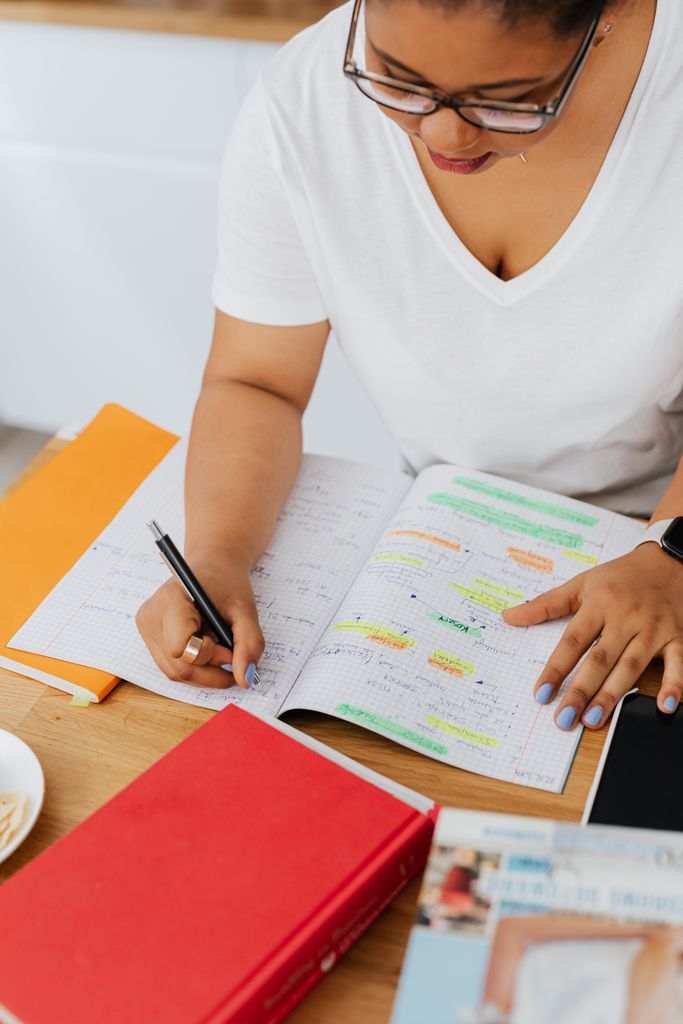
- Block 1 (50 minutes): Priority topic – review, recall, check, summarise.
- Break (10 minutes): Water, walk, stretch.
- Block 2 (50 minutes): Same topic or second subject – practice questions and marking.
- Long break (30 minutes): Meal or fresh air, no phone scrolling in bed.
- Block 3 (50 minutes): Weak topic broken into small parts, with self-testing.
- Break (10 minutes).
- Block 4 (25–30 minutes): Spaced review of an earlier topic plus updating your fix list.
That is roughly three hours of real, focused study. For many students, three focused hours with self-testing produce more learning than six distracted hours with a phone nearby. If you have more time and energy, add one more block. If you have less time because of work or family duties, keep the blocks shorter but keep the order: priority topics first, practice in the middle, review at the end.
How to Adapt the Plan for Different Subjects
The structure stays the same, but the practice changes by subject.
Maths and sciences: Spend more time solving problems than reading theory. Learn a method, watch or read one worked example, then solve several problems yourself without help. Keep a list of formulas and units, and test yourself on them daily from Day 3 onward.
Essays and humanities: Build answer plans. For each likely theme, prepare a short outline with main points and evidence or examples. Practise writing introductions and conclusions, because they frame your whole answer. Learn key terms precisely, since vague wording loses marks.
Languages: Mix vocabulary review with real use. Learn words in short daily sets, then use them in sentences. Practise reading and listening questions under time limits, and review grammar points that appear in your mistakes list again and again.
Multiple-choice exams: Practise reading every option before choosing. Watch for words like “always,” “never,” and “except,” which change the meaning of a question. When you review, explain each wrong option, not just the right one.
For general study skills guidance you can use alongside this plan, the Cornell Learning Strategies Center offers helpful advice on study strategies, time management, and exam preparation for students.
Common Mistakes to Avoid This Week
Starting without a plan. Opening the first page of the textbook and reading forward wastes your best days on whatever comes first, not what matters most. Always start from your graded topic list.
Only re-reading and highlighting. These feel easy and familiar, but familiarity is not the same as being able to recall an answer in the exam. If you are not testing yourself, you are not checking whether you actually know it.
Studying strong topics because they feel good. It is pleasant to revise what you already know, but it adds few marks. Visit your strong topics briefly on Days 6 and 7, and give your best hours to medium and weak priority topics.
Skipping practice questions until the last day. By then there is no time left to fix what practice reveals. Start questions by Day 2 or 3 at the latest.
Pulling an all-nighter. Staying up all night before the exam leaves you tired, slow, and forgetful in the room where it matters most. Sleep is part of studying, not a break from it.
Comparing yourself with classmates. Someone else’s revision timetable, notes, or confidence tells you nothing useful about your own exam. Follow your topic list and your fix list.
Cramming new topics on the final evening. Late new material usually crowds out the solid knowledge you already built. Protect Days 6 and 7 for review and rest.
Final Checklist for the Week
Use this checklist to track your progress. Tick each item as you finish it.
- I made a full topic list and graded each topic A, B, or C.
- I checked the exam format, time, place, and allowed materials.
- I blocked study time in my calendar, topic by topic.
- I covered all priority topics at least once by the end of Day 4.
- I used active recall — self-testing or flashcards — in every study day.
- I completed practice questions from Day 2 or 3 onward and marked them honestly.
- I kept a fix list and reviewed it on Days 4 and 6.
- I completed at least one timed practice paper or long timed set on Day 5.
- I reviewed all my short summaries on Day 6.
- I packed my exam bag the night before.
- I stopped studying early on the last evening and slept properly.
- I ate breakfast and arrived early on exam day.
Conclusion
One week is short, but it is enough time to change your result if you use it with a clear order and honest effort. Grade your topics, give your best hours to the medium and weak areas that matter most, test yourself instead of only re-reading, practise in real exam form, and let your fix list guide your final days. Finish with a light review, a packed bag, and a good night of sleep. Once you know how to study for exams in one week, you can use the same day-by-day rhythm for any future exam.
Remember that this week is a rescue plan for a close exam, not the ideal way to learn. After the exam, whatever the result, build a steadier routine for next time: short reviews each week, practice questions spread across the term, and revision that starts earlier. The students who do well over a whole course are rarely the ones who crammed the hardest in the last week. They are the ones who made small, regular progress and used the final week only to sharpen what they already knew. Use this plan fully now, learn from it, and let it be the last time you need a rescue plan.
FAQ
Can I really prepare for an exam in one week?
You can prepare meaningfully in one week, but you cannot master an entire course perfectly. In seven focused days you can cover the priority topics, understand the core ideas, practise answering questions, and fix your most common mistakes. That is often enough to improve your grade and your confidence, especially if you already attended classes and have notes. Be honest about the goal: strong coverage of what matters most, not perfect knowledge of everything.
How many hours a day should I study in this week?
Quality matters more than a fixed number. For most students, three to five hours of focused study in timed blocks, with real breaks, is a strong and sustainable target for this week. If you have fewer hours because of work or family duties, make the blocks shorter but keep them active, with self-testing in every session. Long, distracted hours at a desk with a phone nearby usually produce far less learning than shorter, focused sessions.
What if I have two or more exams in the same week?
Split each day’s study blocks between your subjects instead of studying one subject for a whole day. Keep the same day-by-day order for each subject: priority topics first, then practice, then fixing mistakes, then light review. Put a little more time into the exam that comes first and the subject where your graded topic list shows the most B topics, since those often improve fastest. Keep one shared fix list per subject so your final review days stay organised.
Should I study the night before the exam?
Study lightly, yes; cram heavily, no. The evening before the exam is for reviewing your summaries, key terms, and fix list highlights in short sessions, then stopping early. Pack your bag, eat a normal meal, and protect your sleep. A rested brain recalls information faster and reads questions more carefully. An all-nighter almost always costs more marks through tired mistakes than it gains through last-minute reading.
What should I do if I feel overwhelmed and cannot start?
Start very small. Set a timer for 25 minutes and study only your single most important topic using the review, recall, check cycle. Finishing one small block usually makes the next block easier. If you still feel stuck, look at your graded topic list and pick one B topic, since medium topics often improve quickly and build confidence. Avoid trying to fix the whole week in your head at once. One block, one topic, one test at a time is enough to get moving again.