Interview Tips: A Complete Guide to Preparing, Performing and Following Up
Good interview tips are not tricks, and they are not about pretending to be someone else. They are simple habits that help you show, clearly and calmly, that you can do the job and work well with other people. Most candidates are nervous, most interviewers expect that, and most hiring decisions come down to a few basic things: did you understand the role, did you give clear evidence from your past work, and did you communicate like a person the team can trust?
This complete guide covers all three stages of an interview. You will learn what to do before the interview, how to perform well during the interview itself, and how to follow up afterwards in a way that helps rather than harms your chances. You will also find worked examples, common mistakes, a final checklist you can use the night before, and answers to the questions candidates ask most often.
Whether this is your first job, a change of career, or a step up to a more senior role, the method is the same. Prepare with evidence, not slogans. Answer with structure, not rambling. Follow up with thanks, not pressure. That is the whole system, and this article explains each part in detail.
Table of Contents
Quick Answer
The best interview tips are these: research the company and the role carefully, match your experience to the job description line by line, and prepare two or three short stories that prove your skills with real results. Practise your answers out loud, arrive early with everything ready, and listen carefully before you speak. During the interview, answer with the STAR method — Situation, Task, Action, Result — keep your answers focused, and ask thoughtful questions about the team and the work. Afterwards, send a short thank-you message on the same day, refer to one specific point from the conversation, and then wait patiently for the stated timeline before following up once more.
What Interviewers Are Really Checking
Many candidates imagine an interview is a test of perfect answers. It is not. It is a conversation with a purpose, and the interviewer is usually checking three things at the same time.
First, can you do the work? The interviewer wants evidence, not claims. Saying “I am good at solving problems” proves nothing. Describing a real problem, what you did, and what changed because of it proves a great deal.
Second, will you fit the way this team works? Every team has habits: how they plan, how they speak to customers, how they handle pressure and mistakes. The interviewer is listening for signs that your way of working will fit theirs.
Third, do you actually want this job? Candidates who have read the job description, learned about the company, and thought about why the role suits them stand out immediately. Interest is easy to see, and so is a lack of it.
Keep these three checks in mind as you prepare. Every answer you give should help with at least one of them. If an answer does not show a skill, show fit, or show genuine interest, it is probably too long or off the point. The most useful interview tips work because they serve one of these three checks, so keep them in mind whenever you choose what to say.
Before the Interview: Preparation That Actually Works
Good interviews are mostly won before you enter the room. Preparation does not remove nerves, but it gives your mind something solid to rely on when nerves arrive. Work through the steps below in order, ideally starting two or three days before the interview, not the night before. The interview tips in this section are ordered so you can work through them calmly, one at a time, instead of cramming everything the night before.
1. Research the Company Properly
Start with the company’s own website. Read the homepage, the about page, and the page that describes the product or service you would help to deliver. Note down, in your own words, what the company does, who it serves, and what it seems to value.
Then look at the job advertisement again alongside that research. Companies write adverts in their own language. If they repeat words like “accuracy”, “pace”, “ownership”, or “customer care”, those words are clues about what they will test in the interview.
If the role exists in a standard occupation, it also helps to read a neutral description of the work, its usual duties, and its outlook. The U.S. Bureau of Labor Statistics – Occupational Outlook Handbook is a reliable place to do this, especially if you are changing career or applying in the United States for the first time.
Write your research on one page. You do not need a long report. You need enough understanding to answer one question well: “Why do you want to work here?” Your answer should connect the company, the role, and your own goals in about thirty seconds.
2. Match Your Experience to the Job Description
Print the job description or copy it into a document. Go through it line by line and, next to each requirement, write one piece of evidence from your own experience.
For example, if the advert says “experience handling customer complaints”, do not just write “yes”. Write the real case: where you worked, what the complaint was, what you said and did, and how it ended. If the advert says “strong spreadsheet skills”, write the specific task you did in a spreadsheet, how often you did it, and what it was used for.
This matching exercise does three useful things. It shows you where you are strong, so you can lead with those points. It shows you where you are weaker, so you can prepare an honest answer instead of being surprised. And it gives you the raw material for almost every answer in the interview itself.
If you have a gap for one requirement, do not panic and do not invent experience. Prepare a bridge answer instead: name the closest thing you have done, say what you learned from it, and say how you would apply it in this role. Interviewers respect honesty with a plan far more than vague confidence.
3. Prepare Short Stories Using STAR
Most strong interview answers are short stories with a clear shape. The easiest shape to learn is STAR:
- Situation: Set the scene in one or two sentences. Where were you, and what was happening?
- Task: What was your responsibility? What needed to be done?
- Action: What did you personally do? Use “I”, not only “we”, so the interviewer can see your part.
- Result: What happened in the end? Where possible, describe the outcome in clear terms: a happy customer, a deadline met, an error reduced, a process made faster, a team helped.
Prepare three to five stories in advance. A good set usually covers: a time you solved a difficult problem, a time you worked well in a team, a time something went wrong and you fixed it, a time you learned a new skill quickly, and your proudest piece of work. The same story can often answer several different questions, so a small set of well-prepared stories is enough.
Keep each story to about one to two minutes when spoken. If your story takes five minutes, it needs cutting. Write the bullet points for each story on paper, practise from the bullets, and avoid memorising a script word for word. Scripts sound unnatural and collapse the moment the interviewer asks a question in a slightly different way.
4. Practise the Common Questions Out Loud
There is a small set of questions that appears in almost every interview, in some form. Questions like “Tell me about yourself”, “Why should we hire you?”, “What is your greatest weakness?”, and “Where do you see yourself in a few years?” should never surprise you.
Work through a full list of common interview questions and answers and note which ones apply to your role. For each one, prepare the main point of your answer in one sentence first. Then build the detail around it. This order matters: candidates who start with detail often lose the point; candidates who start with the point stay clear even when nervous.
Then practise out loud. Speaking is different from reading. Answers that look fine on paper often come out too long, too fast, or too quiet. Stand up, say your answers at normal volume, and time them. If you can, ask a friend or family member to listen and tell you one thing: was the main point clear? You do not need professional coaching for this to work. One honest listener is enough.
5. Prepare Your Own Questions to Ask
Nearly every interview ends with “Do you have any questions for us?” Saying “No, I think you covered everything” is a missed chance and can look like low interest. Your questions show how you think and what you care about.
Prepare three or four questions in advance, knowing you may only have time for two. Good questions usually concern the work itself, the team, how success in the role is measured, and the next steps in the process. Study a prepared list of questions to ask in an interview and choose the ones that genuinely matter to you, then adjust the wording so they sound like your own.
Avoid asking about salary, holidays, or perks in a first interview unless the interviewer raises the topic first. Those matters are important, and there is a proper stage for them later. In the first meeting, questions about the work itself make the stronger impression.
6. Plan the Practical Details
Many interviews are damaged by simple practical problems that have nothing to do with ability. Remove them in advance.
Confirm the time, the place or the video link, the name of the person you are meeting, and how long the interview is expected to last. Plan your journey with spare time, or, for a video interview, test your camera, microphone, internet connection, and lighting the day before. Sit somewhere quiet with a plain background and put your phone on silent.
Choose your clothes the day before. The safe rule is to dress one step more formal than the team’s normal daily dress, with clean, comfortable clothes that let you forget about them once you are seated. If you are unsure about the dress code, it is acceptable to ask the person who arranged the interview.
Prepare what you will bring or have open: copies of your CV or resume, the job description with your notes, your story bullets, a pen and paper, and any work samples the employer asked for. For remote interviews, also have a glass of water nearby and close other programs so notifications do not interrupt you.
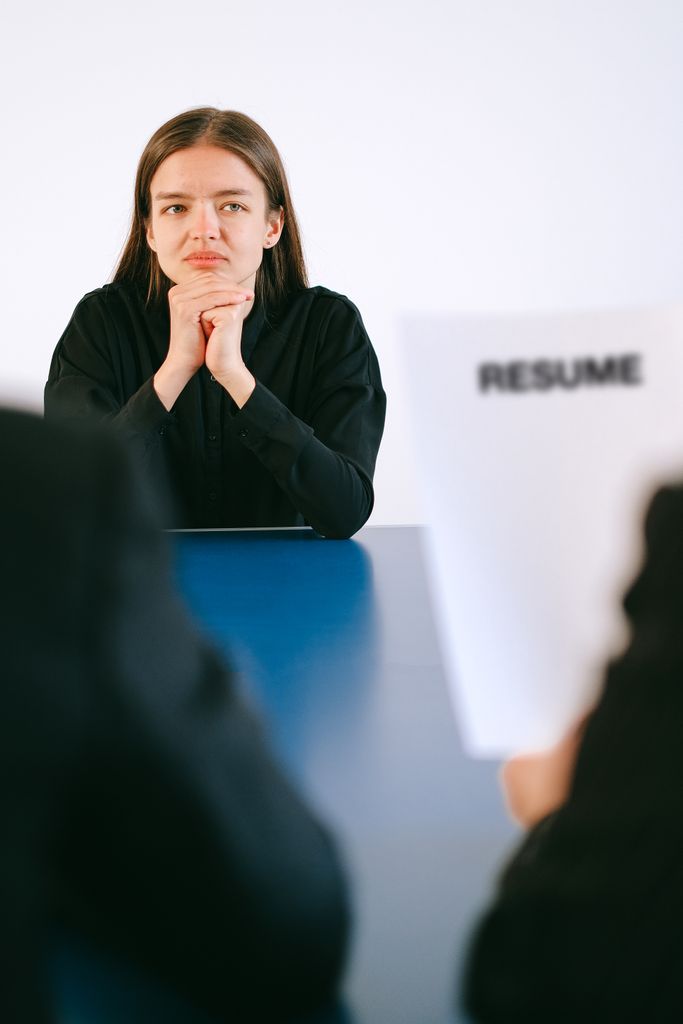
During the Interview: How to Perform Well
Preparation gives you the material. Performance is about how you deliver it: calmly, clearly, and like a person in conversation, not a person reading a script.
The First Five Minutes
Arrive or log in about ten minutes early. Greet everyone by name if you know the names, smile, and keep your opening small talk simple and friendly. Interviewers often form an early impression from how settled and courteous you are, so slow down, breathe, and do not rush your first answers.
When the interviewer describes the role or the team, listen without interrupting and take brief notes if that helps you. You can use details from that introduction later in your answers and in your own questions, which shows you were paying attention.
For the common opening request, “Tell me about yourself”, use a simple three-part structure: what you do now or most recently, one or two relevant strengths or achievements that match this role, and why you are applying for this job now. Keep it to about one minute. It is a summary, not your life story.
Answer With Structure, Not Length
The most common performance mistake is the long, wandering answer. The interviewer asks one question, the candidate speaks for four minutes, covers three unrelated topics, and never quite answers what was asked. The fix is simple discipline:
- Listen to the full question before you start speaking.
- Pause briefly to think. A short, calm pause looks confident, not weak.
- Give your main point first, in one sentence.
- Support it with one STAR story or one concrete example.
- Stop when the answer is complete. Silence after a finished answer is fine.
If you realise you have drifted off the question, correct yourself plainly: “Let me come back to your question — the main point is…” Interviewers appreciate this. It shows awareness, and awareness under pressure is itself a valued skill. That kind of recovery is one of the simplest interview tips to practise, because it works with any question and any interviewer.
Handle Questions You Cannot Answer
Sooner or later, every candidate faces a question they cannot fully answer. How you handle that moment matters more than the gap itself.
Do not bluff. Made-up answers are usually easy to spot, and one dishonest answer can destroy trust in all your other answers. Instead, use this pattern: be honest about the limit, show your related knowledge, and explain how you would find the answer or learn the skill.
For example: “I have not used that exact system before. In my last role I used a similar tool for the same task, and I learned it to a working level in my first two weeks by following the training and practising on test data. I would take the same approach here.” That answer is honest, gives evidence, and ends with a plan. It turns a weakness into proof that you learn well.
Talk About Weaknesses and Failures Honestly
For weakness questions, choose a real but manageable weakness, explain what you have done to improve it, and show the improvement with an example. Avoid the disguised boasts, such as “I am a perfectionist”, which interviewers have heard many times and rarely believe.
For failure questions, choose a real mistake that did not involve dishonesty or serious harm, explain what you learned, and describe what you do differently now. The interviewer is not hunting for a perfect past. They are checking whether you can own a problem, learn from it, and change your behaviour — because every job involves setbacks.
Watch Your Body Language and Pace
Communication is not only words. Sit upright but relaxed, keep natural eye contact, and avoid crossing your arms tightly or looking at your phone or the floor. On video, look at the camera when you speak for key points, and keep your screen at eye level if you can.
Speak a little more slowly than feels natural. Nerves speed most people up, and a slightly slower pace makes you easier to follow and gives you time to think. If you do not understand a question, it is completely acceptable to say: “Could you repeat that, please?” or “Do you mean X or Y?” A clarifying question is far better than a long answer to the wrong question.
Know the Differences Between Interview Formats
The core method stays the same, but each format has small adjustments worth knowing.
For in-person interviews, bring your documents, allow extra travel time, and greet everyone you meet politely, including reception staff. First impressions are formed by the whole building, not only the panel.
For video interviews, test the technology early, use headphones if your room echoes, look into the camera, and keep your notes out of sight of the camera but within easy reach. If the connection fails, stay calm, reconnect, and briefly apologise once — this composure is itself a good impression.
For phone interviews, stand up or sit upright to keep your voice clear, smile while you speak because it changes your tone, and keep your CV and notes in front of you. Because the interviewer cannot see you, use slightly clearer signposts in your answers, such as “There were two main reasons. First…”
For panel interviews, address your main answer to the person who asked the question, but glance at the others as you speak so everyone feels included. If two people ask different things at once, answer one fully, then check you have covered the second.
After the Interview: Following Up the Right Way
The interview does not fully end when you leave the room. What you do in the following twenty-four hours, and the following week, still shapes how you are remembered.
Send a Short Thank-You Message
Send a brief thank-you email on the same day, or by the next morning at the latest. Keep it short: thank the interviewer for their time, mention one specific point from the conversation that interested you, restate in one sentence why you believe you fit the role, and close politely.
For example: “Thank you for meeting me today. I enjoyed hearing how the team is reorganising the intake process, and it confirmed my interest in the role. My experience reducing booking errors in my previous job feels directly relevant to that work. Please let me know if you need anything further from me.”
A message like this takes five minutes and does three jobs: it shows courtesy, it proves you listened, and it puts your strongest matching point in front of the interviewer one more time, in writing.
Write Down What Happened While You Remember It
Soon after the interview, note the questions you were asked, the answers you gave, and any point where you felt weak. This record is valuable in two ways. If you are invited to a second interview, you can build on the first conversation instead of repeating yourself. If you are not selected, you have a clear list of what to improve for the next interview, while the memory is still honest and fresh.
Respect the Timeline, Then Follow Up Once
If the interviewer said they would decide by Friday, do not write on Wednesday to ask for news. Wait until the stated time has passed, allow a small margin, and then send one short, polite follow-up. One message is professional. Several messages become pressure, and pressure never improves a candidate’s standing.
If you receive an offer, thank them, confirm the details in writing, and ask any remaining questions about pay, start date, and contract before you accept. If you receive a rejection, reply with thanks, keep the relationship warm, and, if the conversation was good, you may ask politely whether they can share one area where another candidate was stronger. Not every employer will answer, but the ones who do give you useful information for free.

Common Interview Mistakes to Avoid
Most rejected candidates are not rejected for lacking ability. They are rejected for avoidable mistakes like these:
- Arriving late without warning. If a genuine emergency will make you late, phone as early as you can, apologise once, and explain briefly.
- Knowing nothing about the company. Even ten minutes of basic research prevents the worst version of this mistake.
- Speaking badly about a past employer. It always reflects on the speaker, not the employer. Explain moves and problems in neutral, factual language.
- Giving claims without evidence. Every “I am good at…” should be followed by “for example…” with a real case.
- Talking about salary too early or too vaguely. When the topic does come, be calm, be specific about the range you are seeking, and base it on the role and your research rather than a guess in the moment.
- Forgetting your own questions. Arriving with no questions signals low interest, however strong your answers were.
- Lying or exaggerating. References, tests, and the first weeks of work expose exaggeration. Honesty protects your reputation across your whole career, not just one application.
Read this list the day before your interview. For most candidates, simply avoiding these seven mistakes puts them ahead of a large part of the field.
Interview Tips Checklist
Use this checklist for every interview, from the first phone call to the final meeting.
Two to three days before
- Research the company, its product or service, and its customers
- Re-read the job description and match one piece of evidence to each requirement
- Prepare three to five STAR stories covering problems, teamwork, failure, learning, and achievement
- Prepare answers to the most common interview questions and practise them out loud
- Prepare three or four questions of your own to ask
- Confirm the time, place or video link, interviewer’s name, and expected length
The day before
- Choose and lay out your clothes
- Test camera, microphone, and connection for a video interview, or plan the journey with spare time for an in-person one
- Print or prepare your CV or resume, job description, notes, and any requested samples
- Charge your phone, set it to silent for the interview, and prepare a glass of water for remote interviews
- Get a proper night’s sleep instead of practising until late
On the day
- Arrive or log in about ten minutes early
- Answer with your main point first, then one concrete example, then stop
- Be honest about anything you have not done, and explain how you would learn or solve it
- Ask your prepared questions and note the stated next steps and timeline
- Send a short thank-you message the same day, mentioning one specific point from the conversation
Conclusion
Strong interview performance is not a talent you are born with. It is a skill built from a small number of repeatable habits: research the role, match your evidence to the job description, prepare a few honest stories, practise speaking them aloud, answer with structure, and follow up with courtesy. None of these steps requires money, special tools, or a perfect background. They require a few hours of focused preparation, repeated for each interview until they become natural.
Use these interview tips as a system rather than a collection of tricks. Prepare before, perform calmly during, and follow up properly after, and you give the interviewer exactly what they need to choose you: clear evidence that you can do the work, signs that you will fit the team, and confidence that you genuinely want the job. That is what wins offers, and it is entirely within your control.
FAQ
How early should I arrive for a job interview?
Aim to arrive at the building, or log in for a video interview, about ten minutes before the start time. That is early enough to show reliability and to settle yourself, without putting pressure on the interviewer if they are still preparing. Arriving thirty minutes early rarely helps and can feel awkward for everyone.
What should I say for “Tell me about yourself”?
Keep it to about one minute and cover three points in order: what you do now or did most recently, one or two strengths or achievements that match this specific role, and why you are applying for this job now. Practise it out loud in advance. It is usually the first question, and a clear, calm answer settles your nerves for everything that follows.
How do I answer a question I do not know the answer to?
Be honest, briefly. Say what you do know that is related, then explain the steps you would take to find the correct answer or learn the skill, ideally with an example of a time you learned something similar quickly. Never invent an answer. Interviewers test honesty in these moments as much as knowledge, and a clear learning plan is a strong answer.
When should I talk about salary in an interview?
Let the employer raise the topic first where you can, usually in a later stage or during the offer discussion. If you are asked directly for your expectations in an early interview, give a calm, researched range based on the role, your experience, and the local market, and say you are happy to discuss the full package. Avoid naming a figure in the very first minutes of a first interview.
Is it okay to be nervous in an interview?
Yes, completely. Interviewers expect nerves and make allowance for them, especially for junior roles. Nerves only become a problem when they stop you communicating, and preparation is the cure for that: practised answers, ready stories, and planned logistics give you solid ground to stand on. Slow down, breathe, pause before answering, and remember the interviewer wants the meeting to go well too — they need to fill the role.